The instructions below have been customized for your project "".
Customize these instructions for the project
Available integrations
Of course, our goal is to make redirection.io usable with most of the platforms out there. There are currently several available integrations which are actively maintained by the redirection.io team:
- Apache: we provide a redirection.io Apache module, which is the best way to integrate redirection.io in your platform if you use the Apache HTTP server;
- nginx: integrating redirection.io in a website that uses nginx as the Web server is straightforward with our redirection.io nginx module;
- standalone reverse proxy: the
redirectionio-agentcan run as a standalone reverse proxy, which you can seamlessly integrate inside your infrastructure. Read more about how to enable the agent reverse proxy; - Cloudflare Workers: an easy-to-install Cloudflare worker for enabling all the features of redirection.io on your website. Check out our Cloudflare Workers integration:
- Fastly Compute@Edge: a seamless and feature-full integration of redirection.io for websites using Fastly. Check out our Fastly Compte@Edge integration;
- Vercel Middleware: add redirection.io to you Vercel-hosted website using our javascript middleware package. Check out our Vercel Middleware integration.
redirection.io is also available on several hosting platforms, with a close-to-zero installation process:
- CleverCloud: read more about how to setup redirection.io on your Clever Cloud website.
- Upsun: read more about how to setup redirection.io on your Upsun website.
| Integration | Pros | Cons |
|---|---|---|
| Standalone reverse proxy |
|
|
| Apache module |
|
|
| nginx module |
|
|
| Cloudflare workers |
|
|
| Fastly Compute@Edge |
|
|
| Vercel Middleware |
|
|
Standalone reverse proxy
In many hosting layouts, a Web server like nginx or Apache is not available. It can either be because you want to install redirection.io in front of caching reverse proxies like Varnish or HAProxy, or because your web application server does not require a Web server to be installed (node environments, for example).
In this case, you can still use redirection.io without the need for installing Apache or nginx. Indeed, the redirection.io agent software itself can be executed as a (very performant) reverse proxy, which can scale along with your infrastructure (think scalability):
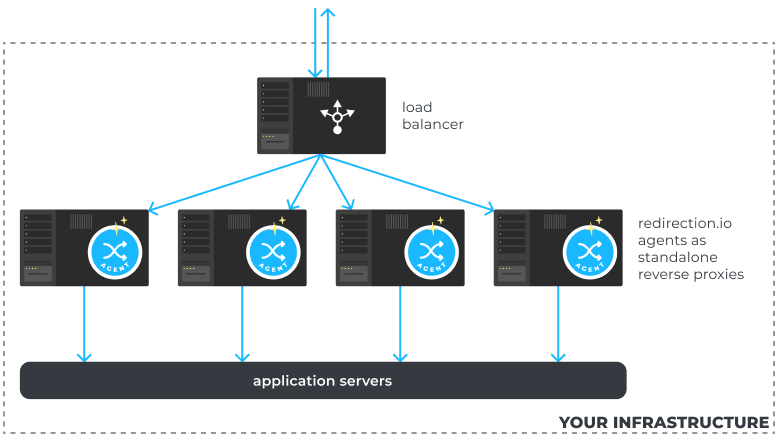
This integration mode can be preferred if:
- you do not have a Web server available, like for example nginx or Apache;
- you are not able to add custom dynamic modules to your Web server;
- you do not want to compile a custom version of the module for your specific nginx or Apache version;
- you want to easily scale your infrastructure.
Installing the redirection.io agent as a reverse proxy is covered in the agent configuration reference. A dedicated page explains the various ways to integrate redirection.io as a reverse proxy in your infrastructure.
nginx integration
This integration is perfectly suited for websites that run the nginx Web server. It provides a native nginx module, developed in C, that listens to all the HTTP requests and applies rules on the fly.

You may choose this integration if:
- you want to use your existing nginx installation / VirtualHost to proxify all the requests, and simply add a native module to nginx to perform redirections;
- you are able to load a nginx native module on your hosting platform.
Read more about the redirection.io nginx integration on its dedicated documentation page.
Apache integration
Very similar to the nginx integration, we propose a native Apache module, also developed in C, that allows to apply redirection.io rules at the server level, using an existing Apache VistualHost.
In this layout, the native redirection.io Apache module is loaded by Apache at startup time, and can be configured in VirtualHosts to listen all the requests and apply rules on the fly.

You may choose this integration if:
- you want to use your existing Apache VirtualHosts to proxify all the requests, and simply add a native module to Apache to perform redirections;
- you are able to load a Apache native module on your hosting platform.
Read more about the redirection.io Apache integration on its dedicated documentation page.
Cloudflare Workers
Using the Cloudflare workers is an easy and straightforward way to integrate redirection.io in your website.

This solution can be chosen if:
- your website uses Cloudflare. In particular, running workers requires that your DNS is hosted by Cloudflare;
- you have an access to the Cloudflare management console;
- you do not want or are not able to install software on your hosting platform.
You may read more about the redirection.io Cloudflare integration on its dedicated doc page.
Fastly Workers
All Fastly customers can benefit of redirection.io by using Compute@Edge, the serverless edge computing solution provided by Fastly.
This solution can be chosen if:
- your website uses Fastly, or you intend to use Fastly;
- you have an access to the Fastly management console;
- you do not want or are not able to install software on your hosting platform.
You may read more about our Fastly integration.
Vercel Middleware
Vercel-hosted websites can use the redirection.io middleware to benefit of all the features of the redirection.io platform.
This solution can be chosen if:
- you want to use redirection.io on a Vercel-hosted website
- you can add a middleware to your Vercel deployment
- you can manage the environment variables of your Vercel deployment
Read more about our Vercel Middleware.